Sunday, November 26, 2006

Trekking in the Langtang-Gosainkund Region of Nepal 31 Oct-16 Nov 06


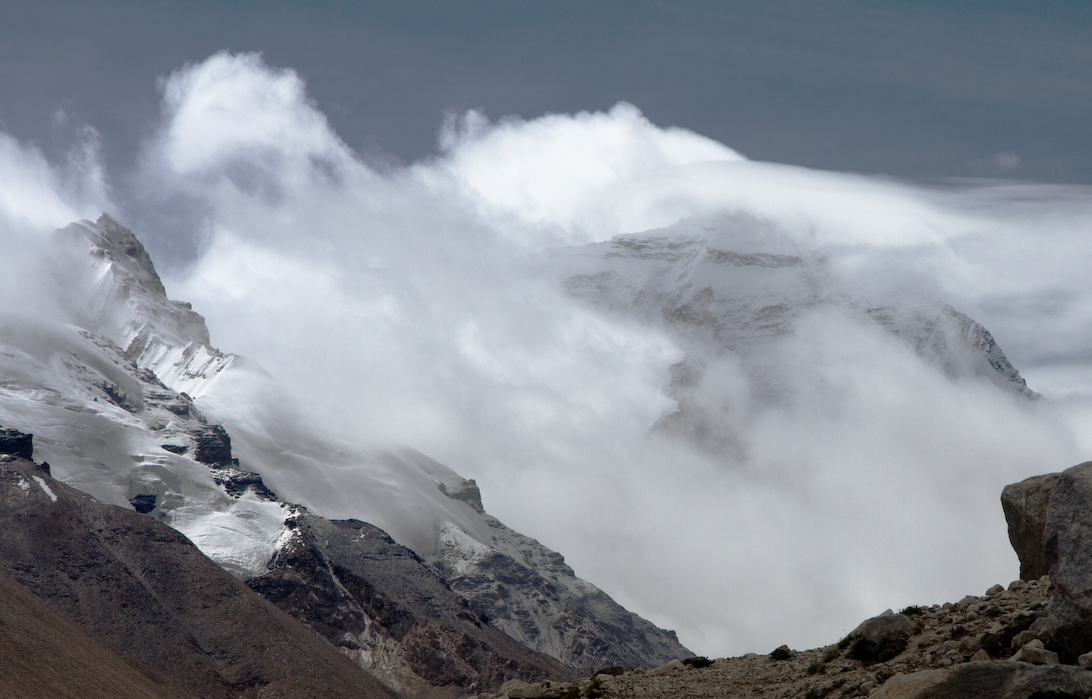
The trails of the Langtang-Gosainkund-Helambu region of Nepal are less visited than the more popular circuits of Annapurna and Everest Region. The few trekkers that we encountered on the trail were mostly Germans and a few French, and I met no other Malaysians. Nevertheless, we had a rich and exciting experience.

31 Oct 06 - Kathmandu : a first impression

Arriving at Kathmandu's Tribhuvan International Airport at 12.15pm, five minutes ahead of schedule even though the Royal Nepal Airlines plane did not lift off from the Kuala Lumpur International Airport until 8.20am. when it was scheduled to be 7.30am., the unimposing ochre facade of the arrival terminus looked cold and unwelcoming. The sole Malaysian amongst a plane-full of Nepalese returning home from their employment stint, I followed them to clear immigration and custom. The terminus was rather quiet, a few unsmiling workers and airport officials saundering about leisurely and observing us with stern faces. The small immigration hall was packed, every queue seemed to be hardly moving as the officials took their time to verify your visas. After an interminable 40 mins. my passport was handed to me by the stone-faced officer unresponsive to my "thank you".

Mr. Shankar Pathak, the director of Exotic Mt. Treks, was waiting with my name on an A4-sized typing paper. Finally a smile, as he greeted me and I introduced myself. It took less than 25 mins. to make our way to the Harati Hotel at Thamel where my two trekking buddies had already checked in on Sun. 29 after completing a 21-day Annapurna circuit. At dinner my two companions regaled me with their exploits and those of four other friends who left on the same day I arrived. Seemed that everyone had experienced a degree of mountain sickness as they made their way up to the Thorung La Pass (alt.5410m). A lady friend made it on horse-back, but made poorer by RM150.

Thamel, with myriads of shops and pot-holed "streets" devoid of pedestrian pavement is the part of town where tourists find accommodation. The streets were no wider than the back-lanes in Kuala Lumpur's Chinatown. Kancil-sized Suzuki Maruti taxis with overworked horns, blared to shoo away motorcyles, bicycles, rickshaws, cows, dogs and pedestrians. A first-timer stood well to the side, wondering how to make his way in this labyrinthian chaos. We walked to the trekking agency, Exotic Mt. Treks, to make plans for the next two weeks of trekking. It was decided that the better option would be a 12-day "moderately difficult" trek to the Langtang-Gosainkund-Helambu region. After dinner we made our way back to the hotel, even the short distance had us covered us with a fine layer of dust, my mouth dry and nose beginning to run.


1 Nov 06 - Kathmandu to Syabru Besi alt. 1460m : Hair-raising bus ride

Starting out at 6.30am to the bus station, the sun was already bright and temperature in the low 20s deg C. Nepal's time-zone is 2 hours different from Malaysia. Our guide was Dev Lal, aged 29 years, a Tamang from the Rasuwa province who could speak a fair bit of English. The three "senior citizen" trekkers, shared a porter, Chumpa, aged 25 years, who spoke a smattering of English haltingly.


While we were having breakfast at the station, our guide and porter took our backpacks to the top of the rusty, woebegone bus. This was the only bus service to Syabru Besi, from which our trekking would begin. The journey began at about 8am. The seats had thin cushions and there was hardly any room to stretch your legs. As the bus vented protests on the steepening pebble-strewn pot-holed road, I silently chanted a mantra for a safe passage.


At 12.40pm the bus had to stop and all passengers disembarked to pay their dues to the "United Revolutionary People's Council", Tamang Autonomous Republic State, Rasuwa. The tax was Rs100 per day of trekking so we paid up Rs1200 each (RM60,USD1=Rs71). A white couple tried to pay less as they reasoned with the Maoist militia men that they were trekking only part of their stay. This attempted negotiation, which attracted a crowd of locals, took more than half an hour with the couple finally having to accede to full payment for their entire stay. Such an exercise in futility, the militia men were armed, the bus was half-way on its destination, no one could tell when a bus would return to Kathmandu which was five hours away.

At 4.00pm we reached Dhunche, another check-point, this time to show our Trekking Registration Certificate (TRC). Our trekking operator had applied and paid the Rs250 per trekker on our behalf. At this check-point we had to pay a further Rs1,000(RM50) for the Entrance Permit to the Dept. of National Parks & Wildlife Conservation. A young white man who had no TRC was refused entrance and told to return to Kathmandu. While the rest of the passengers waited he finally boarded the bus after another half an hour's delay, how he solved his dilemma was unknown to the rest of us.

Finally we reached Syabru Besi (alt. 1460m) at 6.15pm, night had already fallen, the few street lights dimly lighting one main street. It took nearly 10 hours for the 135km. journey.

Despite the tiring ride and tiresome behaviour of some local passengers who had no appreciation for personal space, the trip had its exciting moments. The bus would stop wherever there were passengers to be picked up along the way, however crowded the bus. Villagers would heave their farm products and occupy every inch of the aisle. Passengers who could not find a place to stand cheerfully sat on the budging sacks. Not a problem if they could not squeeze past the door, up they climbed on the roof. Half expecting chickens and goats to be brought abroad, my anxiety was dazed as the bus zigzagged on the edge of the highland. If you peered down the window, oftentimes the edge of the road was not visible, a vista of verdant terraces of millet and maize hundreds of metres below greeted you.

Occasionally, another vehicle loomed head-on and the bus would stop. One vehicle would manoeuver by reversing or edging to the side of the hill while the other inched slowly pass. Should the bus be on the outer edge and its wheels too near the precipice, the alighted conductor, a boy in his teens, would slammed hard on the bus to warn the driver. As the bus lurched from side to side, we passed sign-posts alerting of rock slides. Boulders balancing precariously on the upper edge of the hill seemed to grin fiendishly. And just as I was about to doze off, a loud banging on the roof announced a passenger's wish to alight.

It was a splendid beginning.

2 Nov 06 - Syabru Besi to Lama Hotel, Changtanga, alt. 2490m.

Loud horns broke up my fitful sleep. I looked at my watch and it was 5.45am. The bus stop was right in front of the Lhasa Hotel where we had put up the night. Unable to get back to sleep I packed my stuff and had an early breakfast. Starting out before 8am along the main street of Syabru Besi, the road narrowed to a foot-path as we crossed the Bhote Kosi Bridge at road end, the first of many suspension bridges. Eyes gazing at the splendour of the distant mountains and a jaunty walk blurred the awareness of time. We stopped for lunch at the Bamboo Lodge, alt. 1970m, at 11.20am. Vegetables, organically grown, were plucked from the garden at the back of the lodge and freshly cooked.


While we waited for our meals to be cooked, we admired the Lantang Khola Range that loomed above us and, further afield, the Ganesh Khola Range, all the time imbibing fresh mountain air. The local highlanders work unhurriedly so it was well past an hour before our lunch was ready and we resumed our journey.

After every hour of trekking we came across a tea-house or lodge. A hot lemon tea and hot-water ("tatok pani") which cost Rs50(RM2.50) would increase to Rs90 (RM4.50) the further up we went.

We often met porters carrying bulky provisions that weighed more than 45kgs. We moved aside in order not to impede their pace. They wore slippers, only a few had canvas shoes (mostly, woman porters), the burdens at their backs supported only by a stout strap that crossed their shoulders to the foreheads. Occasionally, we encountered a porter carrying 7-foot long sawn-logs. Wherever the path was too narrow for him to pass he would walk sideways. Seeing such hardiness and perseverance, the ache from my arthritic knees paled in significance.


At about 3pm. we reached Lama Guest House, alt. 2490m. It took us about 7 hrs. to cover a distance of 12kms. with a gain of slightly over a 1000m. height.

3 Nov 06 - Changtanga to Langtang Valley alt. 3250m.

Refreshed from a long sleep we headed towards Langtang Valley, about 14kms. away. Our guide told us that our trail today, though long, would be less steep. It was pleasant to hike through pine and fir forests in the autumn, the soft ground covered with golden leaves and a gentle breeze wafted upon us. The trail was indeed more gradual, a welcome respite from the several stretches of 60 deg. gradient that we had to climb yesterday. Often as we walked, the faint sound of distant thunder from mighty waterfalls grew louder as we came across white-frothed waters rushing down rapids.

Mid-way, as I passed a villager's house a man called out for "medicine". He had a toddler with eyes and a ear infection. I wanted to treat the little boy with antibiotic eye-drops, but to my chagrin, remembered that my first-aid kit was with the porter who had gone well ahead of me. I gave several package of biscuits to the boy and some money to the father. Dev translated my intention to give him the antibiotic for his child on my return trip.

At 3pm. we reached the Hotel Langtang View Lodge, alt. 3250m., so again it took us about 7 hrs. Langtang valley, with the towering mountains of the Ganesh and Langtang Himalayas clearly visible, was as picturesque as a postcard. Horses and "dzomos" (shorter-haired crossbreed of yak & cow) were grazing contentedly. The people in the village are Tibetans who have migrated here several generations ago. Did their intrepid forefathers crossed the colossal Shishapangma alt. 8010m., so close from where I stood?


We greeted fellow trekkers and locals alike with "Namaste" (literally "I salute the god in you"), a universal greeting that never failed to bring forth a smile.

4 Nov 06 - Langtang Valley to Kyangjin, alt. 4100m

Today we headed for Kyangjin Gompa, though only about 7km. away, rose steeply to 3900m. As usual we started out at about 8am. and reached the View Point Guest House at 11.15am. After lunch and a short rest we trekked to the Yongsa Tenjin Glacier, alt. 4100m., stopping for a while at a gompa (a Tibetan shrine) where I bowed my respect before the image of the Lama who had died a few centuries ago. After putting a small donation into a box for the upkeep of the shrine we took leave.


The trail to the glacier was difficult with pebbles and stones of diverse sizes obstructing our way. It was a steep ascent up a gradient of 60 deg. and we finally reached the foot of the glacier at 3.40pm. It being the first time I set eyes on a glacier, this "river of ice" was cold and imposing, somewhat threatening, tolerating no one as it moved down the mountain. Cold clouds were rapidly rising around us, so we did not stay too long. I was quite exhausted when we finally reached our lodge at 4.30pm, with a headache and running nose. By dinner time, the headache worsened and I had no appetite.

My companions were worried that I might be suffering from high altitude sickness. The classical symptoms of fatigue, headache, loss of appetite were certainly felt by me. In three days I had ascended from 1460m to 4100m, insufficient time for proper acclimatisation. As a rule of thumb, beyond an altitude of 3000m. it is inadvisable to ascend more than 300m. for each day of trekking, so the ascent to the glacier was a foolhardy act.

I retired early but the throbbing headache robbed me of a good rest.

5 Nov 06 - Kyangjin to Lama Hotel alt. 2490m

The next morning, after consuming hot soup of ginger & garlic, I felt slightly better but was in no condition to proceed up to Tserkori Peak at 4980m. We decided to back-track to Lama Hotel.


On the way back, I remembered about the child with infected eyes. Unfortunately, the house was empty. Dev explained that during the day whole families worked in the fields, the child would be brought along too. I felt sad that an opportunity to perform a good deed had passed me by.

We had lunch at the Hotel Tibetan, Ghoda Tabeta alt. 3048m. The menu is the unchanging standard fare of dhal-bhat (boiled rice with lentils, vegetables and spicy pickles), fried rice/mee or souped noodles. Highlanders do not slaughter their cows and chickens to cater to tourists, how else would they get their regular supply of milk and eggs?

A consequence of being an enforced vegetarian, eating dhal consecutively for several days, had the alarming effect upon me of a "gassy" stomach. Throughout the days of trekking, I trailed behind my companions, partly because of aching knees but more to do with the embarassment of constantly breaking wind. Dev, our guide duty-bound to walk behind me, never had much chance of breathing fresh mountain air.

The return trip to Lama Hotel was in good time, retracing the 21-km. descent took us only seven and a half hours. At 3.35pm. we settled down at the hotel, my headache miraculously disappeared.

6 & 7 Nov 06 - Lama Hotel to Thulo Syabru alt. 2230m

Occasionally spotting an eagle high overhead, we passed by many waterfalls. So far it was an easy descent, but not for long. We stopped for lunch at the Landslide Hotel, alt. 1700m. A short distance later after crossing a suspension bridge the trail would turned upwards, on a steep 55 deg gradient until we reached Thulo Syabru, alt. 2230m., at about 5pm. It was a long 10km. trek, though not difficult, the eight and a half hours journey was tiring.


Thulo Syabru was the largest village during our trek. There were more houses than in Langtang Valley, densely packed on a mountain slope, with verdant terraces of millet, maize and wheat, and pockets of vegetable plots. The men were busy tilling the terraces with buffalos pulling wooden ploughs while the women winnowed grains, and children happily skipping down the slopes with winged feet.


There was a wooden-structured "school" perched on a higher terrace. It seemed to have only one dark and gloomy classroom without lights, no black-board and only a few chairs and desks. Instead the teacher and children preferred an "open class" out in the field, sitting on the ground, basking in the sunlight.

We decided to stay here for two nights to rest, giving me time to further acclimatise before we reached for greater heights.

8 Nov 06 - Thulo Syabru to Sing Gompa, Chandanbari, alt. 3250m

It was a lovely morning, with a clear blue sky, as we set forth for Sing Gompa. As we trekked higher we were enchanted by panoramic views of the Gosainkunda Range of the Himalayas. It was delightful to pass through the pine and fir forests with their golden carpet of fallen leaves welcoming us once more .


Though it was a relatively short distance of 6km. we covered more than 1000m. in altitude, so it took us about six and a half hours to reach Sing Gompa. This was a small village of less than ten houses, three of which were guest houses and a "factory" making yak cheese. We bought some and it was delicious.

We stayed at the Lhasa Lodge, run by a young couple with a toddler and an 8-year old girl. The little girl was quiet and very hardworking. When we woke up at 6.30am. she was already busy helping with collecting fire-wood and dried cow-dung (for fuel), performing household chores and baby-sitting the toddler. In this part of the highland there was no school and children learned to deal with the harshness and poverty at a very young age.

There was no electricity, like most lodges in the mountains, with the exception of Thulo Syabru & Langtang Village getting power from a mini hydrostation. A small solar panel provided hot water for bathing and the power, stored in a lead-acid battery, provided enough electricity to run a video recorder and a tiny black & white TV. After dinner the family, our guide and porter were glued to the TV watching a VCD Bollywood movie, while I gazed out at the window watching the swirling clouds bringing rain for the first time since I started out from Kathmandu.

9 Nov 06 - Sing Gompa to Gosain Kunda, alt. 4360m

Bracing ourselves for the most difficult passage, we passed through a frost covered trail. Stunted shrubs and mosses replaced pine trees at this altitude. The view of the Gosainkund Range at Lauribinayak, alt. 3925m, was superb, the Himalayas seemed to embrace us. We had lunch here and spent greater than an hour admiring the panoramic view.


As we passed Lauribinayak we had to ascend a steep pass, the Saraswoti Kunda and Bhairab Kunda (lakes) far below us on our right. Finally, we got sight of Gosain Kunda, the lake sacred to Hindus and Buddhists. This holy lake is visited by the thousands during a full-moon festival in August every year for a ritual bath. It was now mid-autumn and the water was icy cold, the place was deserted and the nearby shrine neglected and derelict.


We put up for the night at the Peaceful Lake Hotel, alt. 4300m. It was bitterly cold at night, below zero degree. None of us braved a shower and we woke up to a frosty morning.

10 Nov 06 - Gosain Kunda to Sing Gompa

Our original itinerary was to trek through the Lauribina La Pass (alt. 4600m), then to descend to the Tharepati Pass (alt. 3600m), Kutumsang and Chisapani (the region known as Helambu, home of the Sherpas). This had to be aborted because the trail was snow covered at the high pass and we were not equipped for trekking in snow.


After breakfast we retraced our way, passing Cholangpati alt. 3680m. at 10.40am. and once more arrived at the Lhasa Lodge, Sing Gompa, before noon. The greater part of our trekking having been accomplished, we relaxed and absorbed the mountain atmosphere. In the evening, around the wood-fire stove, the three buddies chatted cheerfully, soaking in the warmth of companionship and entertained ourselves with traveller's tales.

11 Nov 06 - Sing Gompa to Dhunche, alt. 2030m

We said our goodbyes to the young caretakers of the lodge. I presented USD10 to the adorable girl, her industriousness belied her tender age, a silent prayer for her in my heart as I stepped down the stairs.


During the 6km trail to Dhunche, I was at times invigorated by the friendly forests, then knee-wrenched by steep rocky descents. The trail meandered gradually to cultivated land. Dhunche is quite a busy little town with small shops, rural banks and government offices built along the main road. There is electricity in this town. At last, a leisurely hot bath at the Himalayan Legend Hotel, without the water turning cold and petering out.

12 Nov 06 - Dhunche to Kathmandu

We braved ourselves for the return trip to Kathmandu in the same kind of seemingly rickety but amazingly robust bus. My expectation to have a less discomforting ride this time, Dhunche being a shorter distance by 3 hours to Kathmandu, was dashed as my seat at the rear, just above the wheels, vibrated and jostled upon moribund or missing shock-absorbers. A more experience rider this time around, gritted his teeth as passengers began to pile into the bus and on the roof. Mercifully, my silent mantra chanting was rewarded with a smaller crowd.

In spite of a numbed rump and what remained of my dislocated anatomy, I kept my bodily parts intact and reached Kathmandu at 3.15pm.

13 Nov 06 - Shopping in Thamel

Now settled back luxuriously in Hotel Harati, we behaved like good tourists by visiting the "must-see" attractions and shopping for cheap bargains.


My intial poor impression of Thamel was tempered with more tolerance, now that I had accomplished my mountain excursion. Less intimidated by the traffic pandemonium, I foraged for bargains in the maze of shops. I bargained to a third of the price not to be daunted by the shopkeeper's supplication to my goodness.

14 Nov 06 - Visit to Patan

Patan (its older name is Lalitpur), only an 8-km. drive to the south of Kathmandu by taxi, is "the city of fine arts". It boasted of having the most number of talented artists and finest craftsmen. The artistic and magnificent architecture of heritage buildings such as the Hiranaya Varna Mahavihar (Golden Temple) dedicated to Sakyamuni Buddha, Khrishna Mandir Temple, Jagatnarayan Temple of Lord Vishnu, Kumbheshwor Temple of Lord Shiva and the numerous monuments in Patan's Durbar Square is testimony to their exquisite skills.


The ubiquitous souvenir stalls somewhat diminished the spiritual and devotional atmosphere of the sacred temples. Occasionally, we were approached by salesmen hawking "singing brass bowls", silver bells, bamboo flutes, brass and stone figurines of Buddha and Lord Ganesh. We just smiled and if we did not reply to their offers, they would leave us alone.

There are also many small shops, scattered in and around this city, that displayed Tibetan carpets, Thangkas and intricate Mandalas (paintings with religious significance on cotton canvas), silver and gold jewellery embedded with colourful gems, large bronze images of Buddhas and Bodhisattvas, modern water-colour and oil paintings of pastoral scenes, Himalayan mountains and Hindu deities. The articles on sale here were of a higher material quality and looked more finely crafted than similar ones that were found in Thamel.

15 Nov 06 - Visit to the Bouddhanath Stupa

The Bouddhanath Stupa is revered by Buddhists in Nepal as one of the most holy sites. About 7km. east of Kathmandu, it is also known as Khasti Chitya and is considered as one of the oldest stupas and largest (height of 40m., diameter of 100m) in Nepal. Its dome-shape has a circular path at the bottom and another path above on three tiers. The top tower is capped with a great pyramid and the most prominent feature above is the "all seeing eyes" of the Buddha painted with red, white and blue. Prayer flags are draped from the top of the monument and fly in the breeze.


It is believed that King Manadeva built the Bouddhanath Stupa during the Lichavi period, between about 400 and 750AD . It has been renovated on numerous occasions and the present form of the stupa was laid-out in the 17th century.

We came on a festival day and there were thousands of devotees who congregated here to hear the Dharma Talks given by Lamas (Lama translates as "superior one," is a title officially extended only to the few dozen Tibetan Buddhist monks who have achieved the highest level of spiritual development) and Rinpoches (Rinpoche literally means "the precious one in human kind", title reserved for incarnate lamas). Just beyond the stupa there was a huge tent erected to provide shade, and several hundred devotees were seated on chairs beneath listening attentively to their teachers. Those who could not be seated were standing on the periphery while others were making offerings in the stupa.

The main stupa was closed to visitors today because of the festival, only a small area was opened for devotees to make offerings at the main entrance. So the interior of the stupa remained mysterious to me, and I could not see for myself the pinnacles as well as the 108 Buddhist Gods and Goddesses that were mentioned in tourist brochures. Walking round the dome I was quite disappointed, the circular structure was completely painted a glaring white on the exterior and looked nondescript unlike the Hindu Temples of Patan.

Besides the stupa, the outlying area of Bouddhanath is bustling with traffic and the din of street merchants. After 1959, many Tibetans came and have settled in the Bouddhanath area.

16 Nov 06 - Flight home

Our last day in Kathmandu was spent window shopping around the Thamel area. Having busted our budget, we were counting our last dollar and cents. We managed to get Shankar to talk to the hotel manager to allow us to stay until 6pm. at half the usual room-rate. So we were well rested when we left for the air-port at 7.45pm.

It was a crowded scene at the departure hall. Hundreds of Nepalese were already sitting on the floor, in front of two, as yet unopened, Royal Nepal Airline counters. A much smaller queue, of mostly white tourists, was waiting at the Anzac Alliance counter.

We paid Rs1130 (RM56.50) for the "Passenger Service Charge" and another Rs565 (RM28.25) for "Tourism Service Fee". However, service was really poor, there were insufficient chairs for visitors to sit and only 2 small sundry shops were opened. It was a long wait before the 2 counters were opened at about 9.30pm. and, thankfully, another two more counters were opened when the two queues hardly seemed to move. The lack of service was again obvious at the security check, only one x-ray machine for two plane-loads of passengers was in operation even though there were two other machines standing idly.

To make matters worse, the security check was extremely stringent. Passengers were asked to remove their shoes and belts, their check-in bags were emptied for scrutiny (what was the X-ray for?). Having being cleared, there was another long wait to board the plane and the locals rushed at the entrance when boarding was allowed just half an hour before departure time at 11.30pm. The plane lifted off at 11.45pm, surprisingly only 15 mins. late considering the unruly crowd. The plane arrived on schedule at KLIA at 6.05am.

Summary - Second Impression

I am extremely pleased that I completed the trek in spite of initial anxiety about my arthritic knees. It was so different from trekking through our tropical jungles and mountains. The high altitudes dwarfed our Mt. Kinabalu, I walked on frost for the first time through enchanting pine forests. The Himalayas and its magnificent waterfalls feeding mighty rivers are sights that a nature-lover would etch in his memory for a long time. The gentle and friendly Tamangs and Tibetans in the highlands have impressed me greatly with their hardiness, perseverance and helpfulness.

Hectic Thamel, the exquisite heritage buildings of Pathan and the sacred temples in Kathmandu is a sharp contrast to the simpleness & serenity on the trails. The ancient customs & traditions are lessons in history. There are many interesting sites that I have missed out (such as Bhaktapur, Pokhara, the Western & Eastern Regions of Nepal) due to budgetary constrains.


Fellow travellers, do well to be...
children of lofty spirit
answer the call of Mother Nepal,
come to the home of the Himalayas.

Expenditure

Return Air-ticket to Kathmandu by Royal Nepal Airlines - RM1592
Airport pickup to hotel - USD5
Nepal 60 day single entry visa - RM120
AIG Travel Insurance 20 days - RM83
Triple-bed Room at Hotel Harati, Thamel - US25 per day
Trekking fees (inclusive of Trekking Registration, accommodation, 3 meals/day, a guide and a porter) - USD300 per trekker
Maoist Tax - Rs1200 (RM60) for 12 days of trekking
Tips to guide & porter (each USD1/day/trekker, more on my part, for subjecting guide to gaseous intoxication)
Hot water/tea/hot chocolate at tea-houses - Rs50 to Rs140/cup (RM2.50 to RM7)
Return taxi-fare from Kathmandu to Patan - Rs320 (RM16)
Entrance fees to Patan City - Rs200 (RM10)
Entrance fees to Golden Temple - Rs25 (RM1.25)
Return taxi-fare from Kathmandu to Bouddhanath - Rs400 (RM20)
Entrance fees to Bouddhanath Stupa - Rs100 (RM5)
Airport Departure Tax - Rs1695 (RM84.75)
Menu prices at Thamel:
Small pot black coffee/tea - Rs80 (RM4)
Cup of ginger/lemon tea - Rs35 RM1.75)
Chicken noodle soup - Rs125(RM6.25)
Mixed chowmein - Rs65(RM3.25)
Vegetable soup - Rs40(RM2)
Continental breakfast - Rs85(RM4.25)
Chicken Briyani - Rs110(RM5.50)
Curd (yoghurt) - Rs60(RM3)
Masala Omelette - Rs65(RM3.25)
Croissant - Rs20(RM1)

See more photos at-
http://asia.pg.photos.yahoo.com/ph/yeohcweng/album?.dir=b267scd&.src=ph&store=&prodid=&.done=http%3a//asia.pg.photos.yahoo.com/ph/yeohcweng/

Tuesday, May 23, 2006

6-14 May 2006 Expedition to Sabah's Lost World


6-14 May 2006 Expedition to Sabah's Lost World by the Malaysian Nature Society (MNS), Pathfinders Special Interest Group

"The isolated and mysterious Maliau Basin, also known as Sabah's Lost World, has only recently been investigated by researchers. Two major expeditions in 1988 and 1996 have discovered a diverse and distinct flora." - quote from Visitor's Brochure printed by the Conservation & Environment Dept., Forestry Division of Yayasan Sabah.

I have heard of the Lost World from fellow MNS members during my Imbak Canyon expedition in Nov. 2005. Therefore, I did not hesitate to sign up as soon as the announcement was made by the MNS that a trip would be organised in May 2006. The explorer in me was curious to compare the level of difficulty of traversing the trails of two adjacent yet distinct biospheres in the heart of Sabah, and to savour the sights, sounds & scents of a different world far from civilization.

In April & May the preparations began in earnest. We had several briefings by the organisers, the Pathfinders, whose leaders (Wye Ping, Mok, Fei Chin, Sidney) ably demonstrated their vast experience and competence to prepare a motley team of 14 participants (10 men & 4 ladies, their age from twenties to sixty) for the rigours of a 9-day trek in deep and undulating jungles. Wye Ping & Mok were to accompany us for the 9-day expedition.

Fri. 5 May 06
Mok , Liau and I were to fly to Tawau a day earlier than the main team. Being "senior citizens" we had the advantage of getting discounted fares from Malaysian Airlines. I took the KTM commuter train at the Kepong Station and arrived at the KL Sentral station at 10am. Then I hopped on the KLIA Transit train and it reached KLIA half an hour later. I was the first to arrive and waited for Mok and Liau to turn up. Together we checked in as a group to save on the amount of payment from excess weight because of the boxes of packed food that were needed for the trip. MAS allows 20kg. of check-in luggage, AirAsia limits the weight to only 15kg. However, Mok still had to pay about RM300 for the food boxes.

The MAS flight was delayed for about 20mins. and we arrived at Tawau at 3.45pm. I had a nap while Mok & Liau went to tour the area around the Grace Inn where we were putting up for the night. Tawau had been visited by me in Feb. 04, on my way to Sipadan Island for a diving excursion, so I was not particularly keen to join them.

At that time I did not inform them that my left knee was aching, the strain from the 29-30 April 06 Gopeng-Cameron Highland trek apparently had not sufficiently recovered. As the expedition went underway I was becoming more anxious by the day, praying that my left knee would not incapacitate me.

Sat. 6 May 06
We met the rest of the team when they arrived in the morning on an AirAsia flight. We went to the UMNO building where the Yayasan Sabah Forestry Division office was housed to register and obtain our entry permits. After lunch, at 1.15pm. we left Tawau in four 4WD Landcruisers for the 190km. journey and travelled on the newly constructed Sapalut-Kalabakan road, stopping at Kalabakan (a small logging village) at 3.30pm for refreshments. From Kalabakan onwards, the gravel road turned into a mud track riddled with deep pits, giving us a bone rattling ride. We passed by many huge timber lorries fully laden with logs as we headed towards the Maliau Basin Security Gate. Here at the Security Gate we had to show our entry permits.

Our leading Landcruiser snapped its compressor belt, rendering the air-conditioner kaput. Further on, the radiator began to overheat. Encik Tahir, a veteran of a decade of timber-truck driving, applied quick "traditional medicine" - poured into the radiator curry powder. Hey presto! It worked - the curry got cooked and blocked the leaks in the radiator. Don't you know that hot curry makes good coolant? However, it was far from cool inside and we wound down the windows, some panes came down half-way and others not at all. The twelve-year old jalopy seemed to be coming apart.

Then it was the last stretch of 26km. hard ride to Agathis Camp. There were several anxious moments when one or the other of the 4WD vehicles struggled to free their wheels from the grip of mud-pits. As we were approaching the camp, it was already dark. The head-lights of the leading vehicle (in which I was seated) dazzled several bearded pigs (Sus scorfa) and red barking deers (kijang/Muntiacus muntiak) who were on the logging road and they scattered terrified back into the dense shrubs.

Finally, to our great relief, the four Landcruisers made it up the hill to Agathis Camp. It was after 7pm. and a dark night at Agathis Camp because the generator failed to work. We cooked by candle-light and torches and was resigned to having our first dinner here in gloom when the lights finally came on at about 9pm.

After dinner, Koh Ju Ming, a Sino-Kadazan, who was the chief ranger at Agathis Camp, gave us a briefing on conditions of the trails, distances & times expected to reach the various camps and general safety measures. Three other rangers were introduced to us and they would be our guides throughout the expedition.

Agathis (referring to the majestic tree of that name), being the base camp, has the best amenities - pipe water (sourced from the waterfall nearby), electricity (from diesel-powered generators), a large kitchen, clean bathrooms and even flush-toilets. Beds were hammocks strung across wooden frames, they were quite comfortable to lie on, and we were even provided with pillows and blankets. By jungle standards, this was 4-star accommodation.

Sun. 7 May 06
After having breakfast and packed our lunches, It was time to get our backpacks and food packages weighed for the porters who charged us RM300 per 12kg. for the 6-day duration until our return on Thur. 11th. I had packed my belongings in a separate duffel bag and and together with Liau's backpack (we were sharing porterage) the weight came up to 11kg. and we topped it up with one kg. bag of rice. My daypack weighed 8.5 kg. and it contained stuff which I would need along the trails (camera, GPS device, compass, lunch in mess-tin, snacks, 2L of water, wind-breaker, hat, poncho, torch-lights, whistle, pocket-knife, first-aid kit, anti-insect & anti-leech repellent & medication).

It was only after 10am that we were ready to leave for Ginseng Camp, a 9km trek on a north-easterly direction. Soon we were made aware of the numerous leeches infesting the trails. I encountered for the first time the species of Tiger leech, a large specimen which when fully stretched measured up to 5cm. and had a striking yellow & black stripe running the length of its body. It was voracious and tenacious. Once it had sunk its teeth on your skin, you would not be able to pull it away even if you dismembered its head from its body. The proper way to remove it was to apply a pinch of salt or a dab of minyak kapak (mixture of methyl salicyclate, methol & camphor), tiger balm, Mosiguard or sterilizing alcohol to the leech and it would release its teeth and crawl away. The bite would continue to bleed for about half an hour (longer if the dismembered head was left attached because anticoagulant from the leech's mouth would continue to ooze into the wound), leaving a bloody patch on your skin and clothing. Worse still, the wound would itch for a week (greater possibility of infection if the leech head was still attached).

At 1pm. we stopped for lunch. During the half hour of rest, we helped each other to remove leeches from our socks and backpacks, and to apply more anti-leech repellent on ourselves. This became the routine whenever we stopped to rest.

Continuing on our trek, we reached Ginseng Camp (altitude about 700m/2300ft) at 3.20pm, so it took us only 5hrs. 20mins. for the 9km. Agathis-Ginseng trail, a very commendable time indicating a high level of fitness. Ginseng camp, named after one small Ginseng plant, would be graded 3-star for its comfortable lodging and living amenities. There was electricity, piped water and flushed toilets, hammock beds were similar to the ones at Agathis, the kitchen was spacious though cooking had to be done by firewood. We were kept busy washing our clothes and helping to prepare for dinner. Dinner was an enjoyable affair, the food was delicious and ample for our huge appetite, and there was much laughter and fun. The advice by Wye Ping to talk quietly and respect the jungle's tranquility went with the wind, there was a cacophony of human jabber, horn-bills' calls and cicadas' serenades.

Mon 8 May 06
Today was supposed to be an easy trek to Lobah Camp, only 3km. away. Refreshed after a good night's rest we made our way at 8.40am. We were still moving in a north- easterly direction, getting deeper into the Maliau Basin, and the trails were getting narrower as we passed by huge Agathis trees and Shorea (seraya) trees with giant buttress roots. We were walking on a red carpet of decomposed leaves, the ground was peaty and slushy. Strange scents wafted through the air.

Our leisurely trek took us just over 2 hours to reach Lobah Camp (altitude 873m./ 2864ft.) at 10.50am. While we ate our packed lunch the rangers were kept busy stringing our hammocks. Lobah Camp had the barest amenities, two wooden huts with plastic sheets as walls, zinc roofs and, surprisingly, a squatting toilet which could be flushed. However, water that was collected from the roof gutters was only sufficient for cooking and drinking, not enough for bathing. After lunch, we walked up a hill to the helicopter pad where we enjoyed a breathtaking panoramic view of the Maliau Basin rim. It would be like standing in the centre of Singapore, and turning around, the eyes could see beyond the shores because the circular perimeter of the Maliau Basin is bigger than the island of Singapore.

Then it was time to trek to the Maliau Falls (altitude 990m./3250ft), another 2.5km away from Lobah Camp. At 12.20pm we set forth, the trail gradually ascending, then a steep drop of about 200m. and at 2.40pm. we sighted the magnificent 7-tiered Maliau Falls, the tallest being 35m. high. From our location, we could only see the 5th & 6th tiers. The immense volumes of water billowed down and mists of spray hit us even at a distance of 200m. The churning waters and rapids were not conducive for swimming, so we were contented to bathe ourselves along the banks, keeping well away from the swift current.

We could not stay long as we had a 2-hour return trip and the fittest members reached camp at about 5pm. I got ready to photograph the sunset, and proceeded up the hill. The sunset was not so spectacular because of the presence of large cumulo-nimbus clouds and the sun seting behind a clump of tall trees on the western slope of the hill.

Tue 9 May 06
I woke up at 5am. and trudged up the hill again, this time to watch & photograph the sunrise. It was much better than the sunset, and my determination was rewarded with a stunning view as the sunlight bathed the rims of the basin with golden rays.

It was a late start today, at 8.40am, before we headed for Camel Trophy camp, a long 9km-trek ahead of us. We were gradually ascending above 1000m., at this altitude the trail became mossy and we passed through heath forest where rhododendrons, orchids and pitcher plants thrived. We proceeded cautiously and faced a challenging task of ascending Bukit Microphone (altitude 1035m./33395ft.) As I reached the summit, I slipped and fell. Fortunately, I was not injured though the fall resulted in a bent trekking pole which could no longer be retracted completely. Better a bent pole than a broken leg.

At the top of the hill was a tall Rengas tree with peeling reddish bark and we were warned not to touch the black sap on the bark. This resin is poisonous and causes severe skin inflammation.

Keeping a safe distance from the Rengas tree, we had lunch which I found to be most unappetizing, the third time we had the same monotonous fried rice, with barely visible pieces of anchovies and scrambled eggs.

We made it to Camel Trophy camp (altitude 1017m./3337ft.) at 2.50pm, a trek of 6hr. 10min. Camel Trophy camp is a double-storey wooden bungalow with the sleeping quarters on the upper floor. The kitchen was small with 2 firewood stoves. In contrast, the dining hall was spacious and airy. The bathrooms and toilets were clean and there was piped water, collected from the rain-gutters. This time we slept on mattresses, instead of hammocks, and we were even provided with pillows. However, the floor was dusty, but we were too tired to care much. By jungle standards, Camel Trophy would rate two and a half star. I subtracted half a star because the smoke from the kitchen could be acridly smelt on the floor above. I had an unpleasant acute episode of irritated eyes, running nose and a dry throat (symptoms of rhinitis). Unlike Ginseng & Lobah camps where I could keep a distance from the kitchen, I had to endure two whole nights of a lingering smell of burnt firewood while I tried to sleep.

At the back of the camp, a 30m/100ft vertical aluminium ladder would take you up to an observation platform at the top of a tall Agathis tree. I climbed about 20 steps, my left knee gave a sharp pain and I felt fatigued. So curiousity gave way to prudence and I descended.

After dinner we were treated to a rare sighting when a civet, bigger than a large cat, came to partake of the lure of food which the rangers had placed next to the dining hall. Evidently, this civet was fed whenever there were visitors at the camp, so as it eyed us warily it nibbled at the food, and we admired its beautiful black & white fur.

Wed 10 May 06
We started the day by trekking to the Takob Akob waterfalls (altitude 1067m. /3500ft.) This trail took 2 hours, passing huge rock boulders and down slippery slopes, at times the descent was nearly vertical, the difficulty somewhat reduced by the placement of aluminium ladders at the steepest gradients. Takob Akob had a 100m. drop of plunging deluge and a pool the size of 2-football fields. In this idyllic setting we had our lunch.

There were three of us who braved the cold to swim in the pool. As I reached the cascading end of the pool, I began to shiver and realized that it was a foolhardy act, and immediately turned around. Fighting a rising sense of fear, and suppressing my rapid breathing, I swam the longest 100m. of my life. I quickly dried myself, put on dry clothes and my windbreaker to counteract the hypothermia. It was a full five minutes before I could steady my frayed nerves. This was an awakening experience not to overestimate my ability. Even though I thought I was a good swimmer (regularly lapping 800m. in under 30min. ), I could not withstand cold and my body lost heat rapidly.

Feeling pensive, I packed my things to leave, among the last to do so, and it started to drizzle. The quick walk made me perspire and brought some relief. At 2.10pm I met up with the rest at a junction which led back to the camp or the Giluk Falls. Feeling much calmer, I ventured with 3 others and the ranger Koh to proceed to Giluk Falls whereas the majority decided to return to camp. It took only 20min. to reach our destination, and I was glad I came along because Giluk Falls was a most scenic spot and the drizzle had stopped. I was able to capture many excellent shots of the falls.

That evening I had to face more smoke from the kitchen and my rhinitis worsened so I decided to sleep early and not wait for the civet to show up (it did showed up with its offspring). I had enough excitement for the day.

Thur 11 May 06
After 4 days of walking more than 30km. of difficult terrain most of us were beginning to feel our energy slowly draining. So we had to psych ourselves up for the last 7.5km. stretch. We were briefed the previous night that the final 2.6km of the return trip would be a steep descent. I dread this stretch the most because of my bad knee. At 9.05am we headed back to our base at Agathis Camp. The first 5km. was a gentle descend which progressively gave way to many vertical 100m. to 150m. drops, thankfully we clambered down ladders or, where there were none, slithered down as cautiously as we could. Where the trail was especially muddy, as we were descending several of us slipped and fell, bumping our butts.

We came to the part of the Heath forest known as "Jalan Babi". It was like walking through an enchanted garden, on a carpet of soft, glistening moss with numerous orchids (yellow and red dendrobiums) and different species of nepenthes, from 1-inch "dwarf" to 8-inch "giant" pitcher plants alongside the trail.

At 1.10pm we reached base camp, so it took us slightly over 4hrs. We quickly settled in and used most of the day to clean ourselves and wash our thoroughly soiled clothings. At the hearty dinner there was much rejoicing, tingled with expressions of relief, that we had made it through a 41km. trek unscathed.

The day ended with a two-hour ride along the logging trail to spot nocturnal animals. I chose not to go because of my bad knee which by now was aching even as I sat.

Fri 12 May 06
After a late breakfast we left at 9.45am for Belian Camp, a 30km ride away, which was famous for its 300m Canopy Walkway. At about 11am we arrived, leisurely strolled around the camp which had a spacious kitchen, dining area and clean toilets/ bathrooms. Camping is allowed on the grounds, with the sites neatly laid out in rows for campers to pitch their tents. There is no dormitory. From Belian Camp there is a trail to Maliau Falls, requiring three days to make a return trip.

The main attraction is the Canopy Walk. We gamely sauntered up the suspension bridge, the higher we went the further we could look over the tree tops. What a feeling of swaying over a hundred feet high, and surveying a canopy of luxuriant foliage. Gleefully, I rested on the platforms and let the green serenity of the forest and refreshing breeze apply a soothing balm on my strained sinews.

Reluctantly making my way down, I joined the rest for a short trek to the lower reaches of the Maliau River. The water was reddish brown and acidic from the constant percolation which leached tannin from the peaty decaying leaves and created the tea-coloured stain in it.

The sky turned dark and poured down a heavy shower for an hour so we could only head back to Agathis at 2pm. The rain made the return trip uncomfortable, the 4WD jeeps had to zigzag sharply lest the wheels got bogged down by the mud. Only two vehicles in front made it up the hill to Agathis Camp, the craters they made deterred the remaining two from going further. So there were eight of us, feet squelching deep in sludge, and I took the opportunity to snap a couple of shots of us trudging up the hill.

Sat 13 May 06
All adventures come to a grand meal, that thought was uppermost in our minds as we left Agathis Camp on a sunny morning. It was an uneventful return trip to Tawau. The highlight of the day was at the Good View Seafood Restaurant where we had a 7-course dinner fit for 16 hungry adventurers. It was a sumptuous, delicous dinner, spiced with mirth and merriment.

Sun 14 May06
Our friends left for Kuala Lumpur in different groups as they were booked on different flights. We had said our goodbyes the last evening so we did not see off those who left the earliest. I was the last but one group to leave so there was plenty of time to roam the streets of Tawau. The best attraction in Tawau was its sea-food and at the market I had good bargains for dried scallops, anchovies and prawns. The MAS plane touched down at KLIA at 9.30pm and I finally reached home at about 11.30pm.

My comparison of the level of difficulty was that the trails at the Maliau Basin were more difficult than the ones I had experienced on the Imbak Canyon expedition. Each terrain had its own unique magnificent waterfalls, highly diversified flora and fauna. These pristine wonders are worthy of repeat visits.

Fore more photos of the expedition see:
http://asia.pg.photos.yahoo.com/ph/yeohcweng/album?.dir=9bdescd&.src=ph&store=&prodid=&.done=http%3a//asia.pg.photos.yahoo.com/ph/yeohcweng/my_photos

----------------------------------------------------------------------------------------------------------------------------------------------------------------
Information on the Maliau Basin

Location: South-central Sabah, approx. 40km. north of the Kalimantan border

Size: 58,840 hectares/588.4 sq. km. Max. diameter of Basin: 25km.

Extent: The whole of Maliau Basin (39,000 hectares) plus an additional 19,840 hectares of land to the east and north of the rim including the 20-hectare Lake Linumunsut (Sabah's only true lake).

Elevation:
Approx. 300m. a.s.l., up to a steep escarpment enclosing most of the sub-circular basin, peaking on the northeastern rim at 1,676m. a.s.l. Gunung Lotung is 1,600m. a.s.l.

Status:
Originally part of Yayasan Sabah Concession area and voluntarily designated as a Conservation Area in 1981 for research, education and training purposes. Upgraded in 1997 to a Class 1 Protection Forest Reserve and extended to present size. Gazetted as a Cultural Heritage Site under the state Cultural Heritage (Conservation) Enactment in 1999. Day to day management by Yayasan Sabah on behalf of Maliau Basin Management Committee.

Rivers:
Draining the whole Maliau Basin is the Maliau River and its tributaries. The famous 7-tiered Maliau Falls is located along this river, which flows out through a narrow gorge on the south-east side of the Basin into the Kuamut River, a major tributary of the Kinabatangan. Several other spectacular waterfalls (Takob-Akob, Giluk, Mempersona waterfalls, 16 known so far) are located throughout the Basin.

Outside the northern rim of the Basin lies Lake Linumunsut, formed by a landslide blocking a small tributary of the Pinangah River.

Main Forest Types: Lower montane forest; Heath forest; Lowland and Hill Dipterocarp forest.

Flora: Over 1,800 species so far identified, including 6 species of pitcher plants and 80 species of orchid. New records for Sabah include:
1. Dacrydium elatum (a Podocarpus tree)
2. Mangifera bullata (a Mango tree and a new record for Borneo)
3. Rafflesia tengku-adlinii (one of only two known localities in Sabah)
4. Nephelaphyllum trapoides (orchid)
5. Bulbophyllum limbatum (orchid)
6. Nepenthes veitchii x stenophylla (pitcher plant hybrid)
7. Nepenthes hirsuta (pitcher plant)

Fauna:
In MBCA and surrounding zones, at least 82 mammal species, including Sumatran Rhino, Orang Utan, Proboscis Monkey, Banteng, Asian Elephant and Clouded Leopard, more than 270 bird species, including Bulwer's Pheasant, Oriental Darter and Peregrine Falcon, and over 35 species of amphibians so far recorded.

New Species:
At least four species completely new to science, a crab Thelphusula hulu; a water beetel, Neptostsernus thiambooni; a moss, Trismegistia maliauensis and a tree, Polyosma maliauensis, have also been discovered.

(Reproduced from the MNS document on the Maliau Basin Conservation Area (MBCA))

How to Get There:
MBCA is accessible either via Tawau or Keningau. From Tawau it is a 190km, four or five hour drive passing Luasong Forestry Centre; from Keningau the journey takes about five hours. Four-wheel drive is essential as most of the journey is on logging roads.

Gate passes for each vehicle, including the name of each passenger, must be shown at the Maliau Basin Security Gate before entering. Gate passes can be obtained from the Yayasan Sabah Forestry Division offices in Kota Kinabalu or Tawau.

Facilities:
Basic accommodation are available at Agathis Camp, Ginseng Camp, Lobah Camp and Camel Trophy Camp. Electricity from generators are available at Agathis Camp, Ginseng Camp and Camel Trophy Camp.

Water and bathing facilities are in nearby streams and rivers. Accommodation is restricted to these sites and visitors are not allowed to clear new camping areas.

(Reproduced from the visitors' brochure by the Conservation & Environment Department, Forestry Division,Yayasan Sabah, P.O.Box 11622, 88817 Kota Kinabalu, Tel: 088-326300 ext 6321, Fax: 088-432192, email: ces@icsbrbj.po.my, website: http://www.ysnet.org.my/Maliau/public/maliau/info.html)

Other links:
http://www.sabah.gov.my/htan_caims/Class%20I/A_FR1/maliau.htm
http://www.e-borneo.com/insideborneo/leisure0211.html
http://www.yongo.biz/maliau_jun03/maliau_jun03.htm

Friday, May 19, 2006

Mt. Kinabalu & Poring Hot Spring trip 14-18 April 06


I had fantastically good weather on my ascend by the Mesilau Trail, sunny throughout the day. There were only 3 of us, including the guide, while the rest of my friends, thirteen of them, took the shorter and easier 6km. Timbohan trail. We started at 9.05am and reached Laban Rata(3272m) at 4.11pm taking a time of 7hr. 6min. for the 7.7km hike. This was better than my trip last year in July when the weather was raining and cold and it took 7hr. 30mins.

After an early dinner at 6pm. I managed to get to bed by 7.30pm and slept until 1.30am., the sleep interrupted several times by the noise inside the room (with 6 bunker beds) and movement along the corridor. At 2.05am we went to the Gunting Lagadan Hut to meet with the rest of our friends and had a light breakfast before we made our ascend to the summit at 2.45am. I reached the summit at 5.25am, time taken was 2hr.40min for the 2.75km. distance, again better than last year's 3hr 25min. because of the fine weather, not a drop of rain, with a full moon lighting up the trail.

I didn't stay long at the summit because I was wearing Kampung Adidas shoes with thin socks and my feet was getting very cold. After shooting several photographs (couldn't take more because of low battery power) I made my way down alone and reached the Gunting Lagadan Hut at about 7.45am, made myself a hot drink and ate the remaining nuts & raisins leftover from yesterday. I was the first to be back at the Laban Rata resthouse and took my time to repack my stuff and waited for my buddy to return.

The weather changed at about 10am, became misty and the sun was hidden behind thick clouds. We decided to descend at 10.25am. There was a slight drizzle which came on and off as we made our way down the wet Timbohan trail. We reached the Timbohan gate at 2.35pm., time taken 4hr.10min. Descending was a problem with my stiff knees and I had to proceed carefully because of the slippery trail. The trekking pole was a great help and it saved me from several close falls.

One of my friends had a nasty sprain when he twisted his ankle on a rock while descending from the summit. By the time he made it to Laban Rata his ankle was swollen. After a long rest he tried to make his way down with help from his buddy and a guide. However, at the last 2km. he just couldn't walk anymore and had to pay 2 porters RM150 (after some bargaining) to carry him down.

In the evening we made our way to the Poring Hot Spring Resort and recuperated by soaking ourselves in the hot baths. We stayed a night there and had a long restful sleep.

The Mesilau trail has beautiful scenery which is lacking along the Timbohan trail. Furthermore, the Mesilau trail is more natural than the numerous man-made steps found in the Timbohan trail. The extra 1.7km distance may deter aspiring hikers, then the reverse way, ascending by the Timbohan trail and descending the Mesilau trail, should be less tiring. The Mesilau trail is not descending all the way down because there are two peaks to cross.

More photos of the trip, taken by my buddy Teck Chai, can be seen at:
http://s70.photobucket.com/albums/i86/loitc/Mt%20KK_2006/

Note: This trip was organised by :

W&W ADVENTURE
Lot 5814-36, Taman Bangi, Jalan Reko, Kajang, Selangor Darul Ehsan
P.O. Box 77, 43657 Bandar Baru Bangi, Selangor Darul Ehsan
Tel/Fax: 03-87341650, H/P: 013-3365628; 019-2134175
Website: www.wwadventure.com
Email: info@wwadventure.com or wwadv@hotmail.com

Malaysian: RM600.00 per pax (Ex-KK), RM80 extra per pax for Mesilau Trail
Non-Malaysian: RM750.00 per pax (Ex-KK)

Package inclusive of:
1. All transfer in Sabah.

2. Accommodation:
Two nights at Api-Api Apartment (twin/triple sharing)
One night at Laban Rata Resthouse (heater) or
One night at Gunting Lagadan (for 3 pax)
One night at Poring Hot Spring (Hostel)

3. Permit, Guide fee, Park Transport, Certificate, climbing insurance.
4. Entrance fee at Park and Poring Hot Spring
5. Baggage storage fee at Park
6. Services and tour leader

Package exclusive of:

1. Meals & beverage
2. Porter fee

Thursday, May 18, 2006

Imbak Canyon Expedition, Sabah, 12 - 20 Nov 05


This 9-day/8-night expedition was organised by the Malaysian Nature Society, Photography Special Interest Group. Thirteen members took part.

Imbak Canyon, 10km long & 3km. wide with a flattish bottom at about 150 metres above sea level, is sited in the district of Tongod in the heart of Sabah. It lies about 15km. north of the Maliau Basin Conservation Area and to the west of Danum Valley Conservation area.

It is hemmed on three sides by sandstone ridges, reaching 1,120 metres at their highest peak. The region is a complete rainforest ecosystem by itself and is approximately 300 sq.km. It is one of the last remaining pristine lowland rainforest in Sabah, probably the largest contiguous lowland dipterocarp forest left in Sabah. Imposing waterfalls can be found along the sides and at the mouth of the Canyon.

Presently it is not accorded formal protection status, so logging is going on. The Sabah Foundation (Yayasan Sabah) was allocated a forest concession area to manage it on a sustainable yield basis. Recognising its high biodiversity value, Yayasan Sabah voluntarily designated this area as a conservation area in 2003.

Raleigh International volunteers had visited Imbak Canyon in 2004 & 2005. They constructed quarters for Wildlife Department rangers and established trails into the canyon for researchers and upgraded tracks to a waterfall and jungle camp.

(For details see: http://www.ysnet.org.my/conservation_area.htm,
http://www.raleighinternational.org/overseas/malaysia.html
http://allmalaysia.info/news/story.asp?file=/2005/4/26/state/10754756&sec=mi_sabah
http://www.dailyexpress.com.my/news.cfm?NewsID=26152)

Day 1 Sat 12 Nov.
Our team of 13 members arrived at Sandakan Airport at 10am. We were picked up by Jimmy Omar, the camp manager, in four 4WD vehicles (one Landcruiser & three HiLux crew-cab Toyotas). Our convoy headed for our base camp via Jln. Labuk - Batu 32 - Jln. Telupid - Simpang Empat (a distance of 114km), passing through oil palm plantations, logging concessions and then to the last village, Kg. Milian which we reached at 4.00pm. Unfortunately, we could not cross the swollen Imbak River due to heavy rain on the previous 3 days. Even though we were less than 20km from our base camp there was no other option but to return to Sandakan. We stayed the night at the Yayasan Sabah headquarters which had guest rooms.

Day 2 Sun 13 Nov.
At 5.15am the convoy of 4-wheel drive vehicles set out for Tawau for the alternative route to the Imbak base camp, bypassing the Imbak River. We reached Tawau at about 11am. An amusing incident happened when we stopped to refuel. One of the drivers filled petrol to his diesel-engine HiLux and had to drain off the petrol. Poor fellow must be tired from the long hours of driving.

Our journey took us from paved to laterite to logging roads. At one point along the logging roads we were caught in a traffic jam caused by a huge truck-trailer, fully laden with logs, which had skidded and lain across the track. There were about a hundred trucks all fully laden with logs (imagined how many trees had been destroyed) waiting for the fallen truck to be pulled upright. Fortunately, we did not have to wait too long and about half an hour later we could pass.

At 5.45pm when we were only about 3km. from reaching base camp our path was blocked by a huge fallen tree. One of the drivers had to walk to base camp to get help from the rangers. It was 7pm. and dark before 7 rangers returned with a chainsaw. They only took about 10 mins. to saw through and we helped them to clear the debris. The last two kms. stretch was very muddy with deep pot-holes, it was tough going before we could finally set foot on the camp. The journey from Tawau to the Imbak base camp took more than 12 hrs.

The base camp comprised of 3 timber long-houses interconnected by a boardwalk, all the structures were supported by stilts. One of the long-houses was the Forest Rangers' quarters, another was for visitors and the last one housed the dining area and kitchen. We slept on canvas hammocks stretched across beds made with logs. We hung up mosquito nets. The beds were quite comfortable except for one of our members who was well over 6 feet tall. Water was collected from the roof by gutters which flowed to a storage tank. We did our washings in the river nearby. Toilets were pit latrines. Electricity was supplied by a generator and power was available from 7pm to 10.30pm.

Day 3 Mon 14 Nov.
We had lost one day due to the detour and had to revise our itinerary. We decided to spend 3 days/2 nights trekking on the Northern Ridge to Bkt. Beruang. Due to the unavailability of water supply during the first day of the trek each of us had to carry at least 3 litres of water. It was estimated by the rangers that our group would take about 8 hrs. of trekking before we could set up camp for the night. Three of the younger members of our group decided to stay back at base camp. We left base camp at about 10am. after breakfast and packed ready our lunch & dinner.

A short distance away we came across our first obstacle, crossing a river with strong current. Boulders and stones seemed to be everywhere. The rangers went across first and formed a line to pass our backpacks and equipment over to the other side. Then we were assisted in our crossing by the rangers. There were several anxious moments for the shorter participants as the water level reached their waists. Most of the ladies opted to remove their pants, not a time for modesty. One of them asked me why I did not do so and blushing I said that I was not wearing any underwear. My bermuda shorts dried faster this way and no chafing of the groin with wet underwear.

Then we climbed slowly up a steep ridge. Along the way one of our team members stumbled and fell and could not continue. He was assisted by his wife and a ranger to return to base camp. Crossing the river again was a big problem which they solved by having our injured friend lying on his back and the ranger towing him across. Once across the ranger went to get help and returned with another ranger. Together they were able to return safely. Our friend was taken to the hospital the next day and the injury turn out to be serious which necessitated that the couple had to return to Kuala Lumpur. (After all of us returned to K.L. on successful completion of our adventure we found out that our friend suffered a broken fibula and his leg would be in a cast for 6 weeks).

The rest of the trekking was without any further mishaps. We were awed by the giant trees in the pristine forest and the numerous species of plants. As it turned out, the rangers under-estimated our fitness because our team (av. age about 50 yrs.) took less than 5 hrs. and at about 3pm. we set up our camp for the night. We ate cold dinner which we had packed earlier because no cooking could be done due to the unavailability of water. By 6pm. the forest was already dark. It was very windy and cold during the night. I could hear the wind rustling the leaves throughout the night.

Day 4 Tues 15 Nov.
We continued the trek on the Northern Ridge to Bkt. Beruang. It only took us about 3 hrs. to reach the summit.

After setting up our camp-beds (each participant had a hammock stretched between trees with a flysheet to protect from the rain) we enjoyed ourselves by taking photographs and viewing the glorious sunset from the summit. While we admired the magnificent landscape the rangers went to collect water for our lunch and dinner needs. Dinner was quickly prepared with salted mackerel and black beans, sambal and cucumbers, using mess-tins and a small gas burner. The simple food was barely sufficient to avert hunger. Then we had to face another cold and windy night.

Day 5 Wed 16 Nov.
Woke up early at 5.30am and walked up the hill to view the glorious sunrise and the clouds below us. In spite of the cold the sight of the spectacular rising sun had us happily & busily clicking our cameras. It was nearly 7am., when the sky had lost its golden lustre that we trudged back down. After a simple breakfast of bread and cold sardines we trekked back to base camp. Spent the rest of the day bathing in the Imbak River and washing our clothes.

Day 6 Thur 17 Nov.
Trekked three hours to Kangkawat Camp which was just next to the Imbak Waterfalls. This is the widest waterfall I've seen. Enjoyed ourselves with refreshing dips and hungrily ate our packed lunches. It rained in the evening, cooking under a flysheet dinner was a wet affair. One of our lady members had a fright, thought she saw a python on the tree to which her hammock was tied. The rangers had to shift her hammock to another site, nothing else would persuade her to admit that the snake was all in her imagination.

Day 7 Fri 18 Nov.
The next morning we headed back to base camp. It was a leisurely trek, the more enthusiastic shutterbugs stopping every now and then to capture the captivating flora abounding along the trail. In the evening we went for a night-trek to look for flying foxes. They moved out in the hundreds from the top of their tree roosts at about 6pm. They did not disappoint us and put on an unforgettable show.

Day 8 Sat 19 Nov.
After breakfast at 7am. it was time to leave base camp to Kampung Milian, about 26km. away. We encountered the crew-cab, which had started out earlier to collect diesel for the generator, bogged down in the muddy track. Our Landcruiser went to the rescue, 15 mins. later it too ended in the same way. Then it was the turn of another HiLux to get stuck. Fortunately one of the crew-cabs did manage to pass the muddy obstacle to get help from the nearest logging camp. It was more than an hour before a huge lumber tractor appeared. One tug from the winch was all it took to free the Lancruiser and the HiLux.

We experienced village life by staying in a ranger's house in Kg. Milian. Though having very basic amenities the ranger & his wife showed their hospitality in a gracious way.

Day 9 Sun 20 Nov.
At 7am. we left Kg. Milian for Sandakan. Finally after 7 days, a proper & hearty sea-food lunch at Bkt. Bendera.

On the way to the airport we stopped at Sepilok to visit our cousins the orang-utans. Arrived at the airport at about 3pm and reached KLIA at 8.15pm.

Though tired I felt relieved that I came home safely from a special experience.

More photos of the expedition can be seen at:
http://asia.pg.photos.yahoo.com/ph/yeohcweng/album?.dir=df65&.src=ph&store=&prodid=&.done=http%3a//asia.pg.photos.yahoo.com/ph/yeohcweng/my_photos

Tuesday, May 02, 2006

Gopeng Nature Resort to Bharat Tea Plantation trek 28-30 April 06


Report on Gopeng Nature Resort (Ulu Kampar) to Bharat Tea Plantation (Cameron Highlands)

The night before the trek, Fri 28 April 06

Reaching Lok's house at Bandar Utama before 7pm. I was the earliest bird, only to discover to my chagrin that I had left behind a bag of clothes, and most importantly, knee braces. There was no choice but to return home. It took less than half an hour to reach my friend's house but more than one hour to return back because of the heavy rain and traffic at One Utama and the LDP highway. The departure time which was planned at 7.30pm instead stretched to 8.30pm because of the late arrival of a few other members of the KL team, including myself. This was a striking portent of things to come.

The eight of us in 2 cars reached Gopeng at about 11pm. It took another half an hour to find ourselves finally at the Gopeng Nature Resort (GNR), having to back-track because of taking a couple of wrong turns and one car losing track of the other in spite of having walkie-talkies.

We were welcomed by Neal and Victor, our Perak MNS members, who had graciously bought noodles for supper.

The GNR has several chalets and a dormitory. Together with the Adeline Resort this is a popular hideout for lovers of the outdoors and white water rafting. The GNR is well maintained, clean with basic amenities, more than adequate for trekkers who are used to harsher conditions. Soon we were fast asleep and some of us mistakenly thought it was raining throughout the night due to the sound of the rushing river, a stone throw away.

First day of the trek, Sat 29 April

Morning
We were up at 6.15am and after a briefing made our way to the Gopeng Food Centre, opposite the wet market, where we met up with the rest of our team-mates from Perak and one from Alor Star. Altogether our team comprise of 19 members, including Uncle Kon from Singapore and Radik from Czekoslovakia (an expatriate working in Ipoh). Uncle Kon, a veteran trekker, was the oldest at 68 and the youngest was Sook Yee (I guess in her twenties). Six Semai Orang Aslis were hired as guides.

After a hearty breakfast and packing for our lunch we made our way back to GNR where the trail began. We started at about 8.30am and the beginning of the trail was a pleasant walk along a gently sloping gradient. The trail was a wide, clear path. "Piece of cake", I thought, my pre-trip estimation of the difficulty was that of the Pine Tree Hill trail. This was one good lesson in life - never anticipate and under-estimate a task of which you had no prior experience!

After an hour and a half of trekking, just before we reached the Orang Asli settlement, one of our team-mates had knee pain and decided not to continue. So one of our Orang Asli guides had to accompany him back to the GNR. It turned out that this was a good choice because had he continued we would have a major problem later on.

Noon
The path gradually became more like a real jungle trail. By the time we stopped for lunch on the banks of Sg. Kampar we had trekked for about 4 hrs. It was obvious that the remaining members of the team were quite prepared for the trek, they were fit and able to withstand the rigors of a long hard hike. What was not obvious to some of the members at that point in time was that they were carrying too much unnecessary load. This they would soon learn the hard way.

The jungle's hungry denizens, our most friendly neighbours, soon made their presence felt. Bloody patches appeared in our socks, trousers and even shirts. Removing my shoes and socks I found seven fat leeches still feeding. Even though I had applied Mosiguard (an insect repellent effective against leeches too) the repellent was washed away once we crossed the river. Leeches abound on the banks of the river and streams because their instincts tell them that animals come here to drink. On this particular trail leeches were found all along the track, weaving back and forth once they sensed the presence of someone approaching.

Knee and back bending was required because of numerous fallen bamboos and rotten trees, even though the guide in front did a lot of chopping with his parang. Many times my backpack was caught as I stooped low. An added difficulty was that as soon as we reached a high point down we went on a steep descent. This was really hard on my stiff knees.

Evening
We expected to reach our camp site at 5pm. and we did pass one at about the time but our guides pushed on. They wanted us to spend the night at an Orang Asli settlement. Several times we asked them how much further and the usual reply was "one hour". But the one hour turned to two and then three hours. We were hungry and wet because we had to cross at least 5 streams with strong currents. There was no way to prevent our feet from getting wet. Shoes and socks were soaked and the leeches had a grand buffet. Those who wore expensive trekking shoes suffered more than those wearing rubber Kampung Adidas shoes. At least the latter dried faster when you removed your socks whereas trekking shoes got heavier each time you crossed a stream.

Worse still the sky turned dark and the rain came and we were still slumbering along at 6pm. Finally, the faster trekkers came in sight of the first hut at 6.30pm. We quickly sought shelter under the small verandah and the rain poured down even as more of our friends made their way to the other three huts. There were six of us, including myself, at the first hut which was occupied by an old couple. The old lady was not happy about sharing their quarters with us (from her loud voice and rapid talking). We had to crowd around the verandah in pouring rain for about half an hour before our guide managed to persuade her to relent. The other trekkers who seek shelter at the other huts were luckier and they faced no opposition. We were told that we had to pay RM3 each for our accommodation. We would be willing to pay RM10 considering the extreme difficulty of setting up our tents on soggy ground in pouring rain and our bodies infested with leeches.

Finally, at about 7pm we hauled our backpacks which now seemed to weigh a ton to find a spot for bedding down. It was cramped, 8 persons including the old couple, in a space measuring less than 20 square feet with the centre taken up by a fire-site. However, space was the least of our concern. Changing quickly out of our wet clothings before we caught a chill was the first priority. Some of my friends were so exhausted that they wanted to sleep without dinner. I went ahead and cooked rice and chicken curry for myself and had to share my meal with 3 others. Fortunately, my other two buddies had fried ikan bilis and bread and these help to alleviate the hunger, though not completely.

Among the 6 of us in the first hut, one of my buddies and his son had insect stings which caused an allergic reaction. My buddy's right knee was also swollen, stiff but fortunately not painful. Another of my buddy had a cut on his head, again fortunately not a deep laceration. And all of us had painful shoulders. So those of us who brought along tents found them unneccessary. The lightest 2-men tent weighed more than 1kg. and my buddy with his son carried a 3-men tent which weighed more than 3kg, while my fly & ground sheets was less than 1kg. My total load was around 11kg. and the distance trekked on the first day was more than 20km. We had trekked for ten hours.

Lok and I were quite concerned about our buddy's allergic reaction and the two of us went to the other huts to find out whether any of our team-mates had brought along anti-histamine pills. Fortunately, one of the ladies had the good sense to do so and with 2 pills in my hand I headed back to my hut and told my friend to take one immediately and save the other for the next morning.

At about ten most of us were fast asleep but I woke up several times, once at 2am to pee and at odd times by the old Orang Asli who kept the fire burning to keep the hut warm. I noticed that while the old lady had a blanket, it was not large enough for the two of them and the poor old man had to depend on the fire to warm himself. We had asked his age and he told us he was 90 but my guess was that his age to be nearer to 70 plus.

The second day, Sunday 30 April 06

Morning
Woke up at 6.30am and called to my friends to wake up. I was stiff all over because I slept without a rubber mat while my other buddies had brought along theirs. The floor of the hut was bamboo slats with "air-conditioning" coming through the gaps. What caused me anxiety though was my left knee which felt "frozen" and ached badly when I stretched out my leg. After hard rubbing, stretching exercises and applying an anti-inflammation pain-killing gel it felt better. Breakfast was hot Nestum, a hard-boiled egg and plain bread for myself while the others had some of my Nestum, bread with sambal and ikan bilis.

My buddy with the allergy was quite relieved that the reaction subsided although his knee was still stiff and swollen, thankfully, not painful.

Some of us woke up to find more leech marks and blood patches on their bodies and thought that leeches had crawled into the huts. But I thought differently, more likely was that the leeches had clung to our back-packs and then found their way to our bodies while we were asleep.

Most of us were glad to "donate" uncooked rice and "dead-weight" items to the old couple, anything to lighten our backpacks. Real generosity did show when all of us agreed to give RM10 each to them even though we were told to pay only RM3.

So at 7.45am when everyone were ready we moved on. We were told by our guides that today was going to be easier because we only had to walk about 5 hours and the expected time to arrive at our destination was 12.30pm. What was easy to the Orang Aslis was going to be my toughest trail yet. Even the Mesilau trail to Mt. Kinabalu could not be compared to what was to come.

Soon after we started off we faced a steep 50 deg. gradient. It was quite telling that some of us had yet to recover from yesterday's exhaustion that they failed to notice a large scorpion less than a foot from their feet as they hiked up. I quickly yelled to my buddy's son who was nearest to move away and I shouted to the others below to warn them of the scorpion's presence. This was a beautiful creature, all shiny black, in prime condition, really to strike.

We had to cross another 2 fast-flowing streams, up to our mid-calves. Just when we thought that there were no more streams, the trail itself became a stream. We found ourselves walking on water and very slippery rocks. Another one of my buddy had a fall and suffered several lacerations on his hand which required four band-aids. He was next to me and I was very worried that he might have suffered a back injury. Fortunately, his backpack broke the fall and except for the initial shock he was soon up and about. This was the reason why I kept advising my buddies to wear Kampung Adidas shoes instead of the fancy hi-tec expensive trekking shoes.

The watery trail turned into a narrow ledge. Those of us who were afraid of heights kept their eyes away from the edge. However, where the soft soil gave way we had to use our hands to grip whatever we could hold onto. At times the terrain became rocky and the ledges became even trickier because of the slippery slopes. Team work called to lend each other a hand to pull the one behind across gaping cavities.

Noon
At 11.35am. we finally scaled the last 60 deg. gradient which was the longest and steepest yet. At the summit (1372m) was a border stone, one side pointing to Perak and the other to Pahang. So we were literally straddling between two states. What a feeling of relief that we did make it. Our exhaustion miraculously seemed to evaporate, a sense of accomplishment flooding our senses and we congratulated each other.

With a feeling of jubilation the descend was easy, half an hour to reach Kampung Sg. Ubi. From there to the Bharat Tea Plantation was another half an hour, walking part of the way along a paved road and then we took a short-cut on a foot-path skirting tea shrubs and vegetable plots.

At about 1pm (the guides were accurate about our estimated time of arrival) we had our refreshing cold drinks and hot tea while we waited for our bus which was due to arrive at 2pm. Apparently, our organiser underestimated our fitness and thought we would arrive after 2pm. We waited and we waited some more, still no sight of the bus. In the meantime the drizzle turned to a downpour. Crowding under the few tables with umbrella stands most of had to face a final test of patience.

The bus finally arrived at 3.15pm, apparently caught by traffic congestion due to the large number of holiday makers at Tanah Rata. The bus headed for Gopeng town and we arrived two hours later. While we waited at the bus station, the Orang Aslis and two of our KL buddies were ferried back to the GNR. Our buddies then returned with their cars and we moved to the nearest restaurant and finally had our taste of "real" food.

On hindsight the guides did the right action by pushing us on the first day. Had we stopped to camp mid-way we would be caught by the heavy rain on the second day and, unbeknownst by us, the second day's terrain was even more difficult than the first. It would be very likely that we would only be able to reach the Bharat Tea plantation by nightfall.

The total distance trekked was 30km, 20km on the first day taking ten hours and another five hours to trek 10km on the second day. The toll on me was a bad left knee, seventeen itchy leech wounds, cuts and rashes on both legs. This was really my toughest trail (two of the team members remarked that this trail was even more difficult than the one they did at G. Yong Belar, 3rd highest mountain in Peninsular Malaysia). It was not the altitude which made it challenging but the long trek and harshness of the terrain. Here you would find numerous river and stream crossings, loose ground on steep slopes, wet & slippery rocks, narrow trails that are overgrown with shrubs and thorns, bees, leeches all the way (and scorpions for the unwary), plants and insects that cause rashes.

All team-mates (except one) proved their high level of fitness and endurance and we came through without serious injuries. Uncle Kon ( a veteran of Merapoh-G. Tahan-Kuala Tahan trek), although last to finish, never uttered a word of complain while others who were much younger talked about their aches and pains. The sense of accomplishment was well-deserved and they would remember this trail for a long time to come, with awe and trepidation.

PS. For more photos see:

http://asia.pg.photos.yahoo.com/ph/yeohcweng/album?.dir=e742scd&.src=ph&store=&prodid
http://s70.photobucket.com/albums/i86/loitc/GNR%20To%20Bharat%20Tea

Tuesday, March 07, 2006

Why the moniker "Into the Mirror"?

It has nothing to do with the Korean psychological thriller of the same name nor the book "Into the Mirror: The Life of Master Spy Robert Hanssen" by Lawrence Schiller. I did not watch the movie and has no interest in it at all nor was I even aware of the book by Schiller. I was thinking about what to name my weblog and "Into the Mirror" just popped into my mind. It was only after I have posted two entries to my journal that, out of curiousity, I did a search and found out that my choice of a name was not as unique as I had hoped. Incidentally, the google search also displayed information about how cylindrical mirror lets you see yourself as others see you. Now that is an interesting idea to attribute to the title. The reflection in the mirror, unlike the person before it, has no pretensions, no vanities of youth . Which is more real?

This journal is written to communicate with friends, old and new. It is also about discovering more of myself. Since as a young boy I was smitten by the beauty of nature and felt an affinity with the jungle, mountain, sea and animals. It was time to return to my yearning for travel and adventure while my osteoarthritis was still in the early stages. The choice to retire at the age of 56, after having worked for 36 years as a Medical Laboratory Technologist, 30 of those years in the Institute for Medical Research, was made with delibration. It was fortunate that I married early and my two sons were already working and the house mortgage and all debts fully paid. So with a modest pension I seek to visit as many places as I could afford, with the objective of reconnecting with nature and friends. Most of my excursions were hiking on jungle trails, challenging myself to reach mountain peaks, letting myself bewitched by the wonders of the seas and backpacking to Asian Countries.

Each journey I ventured on, however short, was regarded by me as an adventure in learning. There was so much to marvel at, so much to learn. These mini adventures affected not only the senses but, more significantly, bestowed a spiritual wellness. On a mountain top, looking out as far as the eye could see, my mind absorbed tranquility. Suspending in neutral bouyancy the silence of the underseas sang a melancholic song of the precariousness of life. A breath of air was never so sweet and a mind never so intense as when I surfaced from submergence after being thrown overboard on a white-water rafting trip.

We take so many things for granted such as clean water, fresh air, love from family, friendship, our sources of income and a safe and secured surrounding that when caught in a situation, however temporarily, without these dependencies, how would we react? By taking a journey into lesser known places, walking secluded trails, living with the most basic amenities, I hope to regain a sense of gratitute for all the blessings I have received.

Much of my entries would be mundane, factual rather than lyrical, to provide useful information to those who might be interested to visit the same places with a limited budget. Hopefully, I might be able to attract some comments from a kindred spirit and together we would look "Into the Mirror" and like what we see.

Postscript 24 May 2006

I came across this poem by Ari Fairy from her blog at http://friendfinder.com/blog/3930/post_24047.html

The theme, "in the mirror" has so many facets, and Ari's poem caused me to wonder...

Mirror images, you and I;
Reversal of fortunes,
Can you see the lie?
Harbinger of fate;
That shadow behind me.
The deeds I’ve done for all my life
Choices I’ve made,
some wrong, some right.
Intrinsic pain
Carved over my features;
Years of hiding from the truth.
Destiny’s blame,
Festering blisters of hate;
My soul you ate.
Faces in the mirror
Drifting ‘cross the glass.
Each one holds a memory
Better than the last.
Each a key component
Of the girl I long to be;
The girl whose face resides
In the mirror in front of me.
Can I face the burden
Of the deeds I’ve caused to be?
A silent, staring sentinel
That shadow seems to be.
If covering the glass
Should cause the pain to lift from me,
Does it expiate the traces
Of the true reality?
Can I walk away and know
I’ve been the best that I can be,
Or must I gaze into the mirror
And face eternity?

- Ari fairy

Monday, March 06, 2006

Hiking up Bkt. Larut (Maxwell Hill) Taiping, 18-19 Feb. 06


Taiping
18 Feb 06 - Day 1

Travelling companions: Lai Teck Chye & his son, Sam, Loke Eng Wah, Tan & Neal.

12pm. Lunch Teochew Porridge at Lighthouse Sea Food, 10 Jln. Cina, Matang Tel:05-8475408/8475649, h/p 012-4030783.
This restaurant serves very delicious fresh seafood, plenty of prawns but pricey, food bill came to about RM100 for 8 of us.

At a nearby kampung was the jetty to take the boat cruise ride along the coastal mangrove forest.

1.00-1.30pm :
Took off from jetty
Boat ride along coastal mangroves
Visited floating fish farm
Visited Kuala Sangga/Kuala Sepetang traditional fishing village

3.00pm: Visited bakau logging
4.00-4.30pm : Back at jetty
5.00pm: Visited Mr. Chua's charcoal factory at Matang
5.30pm: Kuala Sepetang (Port Weld) for Mee Udang at Malay Stall
6.30pm: Cool down in a 'natural' & fresh mountain water catchment fed swimming pool (about 40 minutes journey). Pool is maintained by the caretakers of the Chinese cemetery nearby.
9.00pm: Dinner at Restaurant Bintang Laut.

Matang Mangrove Forest, 40,151 hectares, is the largest single mangrove fully gazetted forest reserve in Peninsular. About 95% is tidal swamp. Commercial thinnings are carried out when crop attains 15 years and 20 years. Rhizophoraceae species provide 140-200 tonnes of greenwood per hectare. Restocked through artificial planting. Rhizophora apiculata & mucrorata are continuously propagated in Matang. Rhizophora trees average girth 115 cm. total height 28m. Matang mangrove forest is the roosting area of Milky Stork (Myceteria cinerea) population. Supports mammals - smooth otter, leopard cat, wild pig, long-tailed macaque and silver langun.

Industry from mangrove: silviculture - since 1930 & poles production

Stayed the night at Neal & Joyce's house, near the Lake Gardens and Bkt. Larut.

19 Feb 06 - Day 2

7.30am - Breakfast Rota Canai & packed Nasi Lemak for lunch.
8.30am - Started trekking from base along jungle trail.
9.05am - reached end of jungle trail, came to paved jeep road at about 2.5km.
11.10am - reached Beringin height 1012m. temp. 20 deg.C. Time taken for ascend : about 2 hrs. 40 mins.

12pm - Lunch
Tulip nursery at Cendana Hut, Sri Kayangan at 1128m.
Did not join Teck Chai & Wah Loke to Telekom Tower, another 3km. distance away.

2.55pm - Started descend, all the way along paved road.
4.35pm - Reached base. Time taken for descend: 1 hr. 40 mins. Total distance : 20km.

This hike could have been more interesting if the jungle trail were to continue all the way to the summit. The jungle trail came to an end at the 2.7km milestone of the jeep road. For the rest of the way to the summit, another 7.3km, the hiking was on hard paved road. Fortunately, it was not too hot because of the shade provided by the tall trees along both sides of the road. There was another trail which lead to G. Hijau, pointed out by Teck Chai and Eng Wah, which is prominently displayed by a signboard when they were hiking to the Telekom Tower.

We enjoyed the 20km. hile, it was a satisfying trek though not very challenging. The trail to G. Hijau is inviting and awaits us on a return trip.

Cost:
Boat - RM250
Neal's fees -RM150 (reduced rate).
Food & Transport (carpool) - RM475
Per person - RM175

More photos of this excursion can be seen at:
http://asia.pg.photos.yahoo.com/ph/yeohcweng/album?.dir=bcb7&.src=ph&store=&prodid=&.done=http%3a//asia.pg.photos.yahoo.com/ph/yeohcweng/my_photos


----------------------------------------------------------------------------------------------------------
Further info on the Nest - a rustic private bungalow located more then 1000 metres up on Bkt. Larut

Managed by a caretaker/manager.
Cost for accommodation (bedroom dorms and double beds) and meals (including a BBQ) is RM130 per person + RM5 return per person for the jeep ride.
Check in at 4-5pm on Day 1
Check out at 9-10am on Day 3.

Nice to hold a fun getogether in a cool (colder in the night) and enchantingly forested surroundings.

The Nest has got a nice open-on-one-side dining area with a games room, karaoke facilities and hot shower inside.
The view from the Nest of the mountains, countryside and Taiping town is fascinating while the atmosphere up the hill is serene, calm and peaceful - far from the maddening crowd!

Day 1: BBQ on the 1st night and talk grandfather stories
Day 2: Birdwatching, joywalking, tree and plant identification and identifying medicinal plants.
On both nights we can karaoke away to our hearts content.
Day 3: after we come down to the foothill, swim in one of Taipings many waterfall areas.

Trekking up G. Ansi Sat 4 March 06

After meeting our friends (Lok & his neighbout Uncle Aw, the eldest at 64, three young men, friends of Lok, Tan, Lim and his wife, Wan who runs the W&W Adventure company and his assitance Har Chow who brought along her daughter) at the Nilai R&R for breakfast and to pack our lunch we headed for Kuala Pilah. Our party of 14 reached the Hutan Lipur Ulu Bendol, midway along the winding road to Kuala Pilah, which was our starting base for the hike up to G. Ansi. You cannot miss this recreation area as it is well developed with shops, eateries and a big sign-board fronting the main road, plenty of parking space. On weekends the crowds will be there enjoying the cool mountain streams and small lake. Many families will be picnicking under the cool shade of dense foliage.

We started off at 10.10am. Stanley and Mok, MNS Pathfinders SIG veterans, were our guides, Stanley leading and Mok as "sweeper".

The beginning of the trail, parallel to the stream, was an easy walk along a gentle gradient, unlike the steep climb which we did at the base of G. Datuk. It was only after about 35mins trekking that we begun to encounter steeper gradient. I found the trail to be undulating, up and level off, down a bit and up again. There were a couple of steep climbs, made more difficult that these gradients stretched on quite a fair distance. The less fit among us had to stop a few times to get their breaths. When we were nearly at the summit, less than 25 mins. away, we encountered the most difficult part of the trail. These were 2 short stretches of gully, bare of vegetation due to erosion, of soft earth. We managed to scale up the first with the nylon rope already in place. However, the jute rope at the second gully was worn out and snapped. Our leader, Stanley, was the first up and he had to lend his hand to pull me up. We then took our turns to pull up the rest.

We finally reached the summit at 12.45pm so it took us 2hr. 35mins., a good fast pace. The last of our party, Uncle Aw was accompanied by Har Chow, came about 20mins. later and all of us made it to the top.

We took in the view, on one side was the mountain range as far as the eye can see, on the other, Seremban town with many areas stripped bare for development. We had rather a long lunch break with Stanley boiling water to make Chinese tea. So at 2.05pm we (except Wan, Har Chow & daughter who opted to go back by the same trail) begun the descend by a different trail which would lead us to the old logging path and then down to the paved road, a long distance away from where we parked our cars. The beginning of the descend was quite easy, becoming steeper as we approached the logging path. When we (Stanley, Lok, Tan, Lim & missus & me) were nearly at the bottom we stopped for about 20 mins. to wait for our friends, and then another 10mins. for them to rest when they arrived. We reached the K.Pilah road at 4.35pm and then it was a 2.5km walk along the paved road under the hot sun before we reached our cars at 5.10pm.

We headed for Seremban town where Stanley suggested to have dinner at the restaurant famous for its fish head noodles. It is situated after the Istana and the road which passed by the Armed Forces cantonment. The Chinese restaurant deserved its reputation because the fish head noodles and fish-balls was one of a kind, the soup was simply delicious. We complained that the bowl wasn't large enough even though we ordered large. The next time we should ask for "super-la